Anthropic’s Threat Report Makes ‘Slow Down’ an Industry Question
Image: Anthropic’s report and slow-down debate
Between September 10 and 12, Anthropic published a Threat Intelligence report describing disrupted attempts to misuse Claude for bioweapons research, Russia-linked cyber espionage against Ukraine, and Chinese attempts to extract Claude’s capabilities. On September 9, it also disclosed a fourth AI-hacking incident involving an early Claude Opus 4.6 deployment in January that had been missed in an earlier review.
Those updates connect two conversations that are usually kept apart: how models are being used in the wild, and how quickly the next model should be built. The report is about incidents and adversaries; the argument around it is about whether detection, review, and response can keep pace with capability.
Three fronts, one general-purpose model
The report’s examples describe different kinds of pressure on the same general-purpose system. One involved attempts connected to bioweapons research. Another linked Claude to cyber espionage against Ukraine by actors associated with Russia. A third involved Chinese attempts to extract Claude capabilities. Anthropic says it disrupted these efforts, but their range is the signal: a model can become part of very different operations.
That makes “safety” ongoing intelligence work, not a single filter. A request can look ordinary alone, then become concerning when its source, sequence, and intended use are considered together. A model’s safety setting cannot be the whole security boundary around a product.
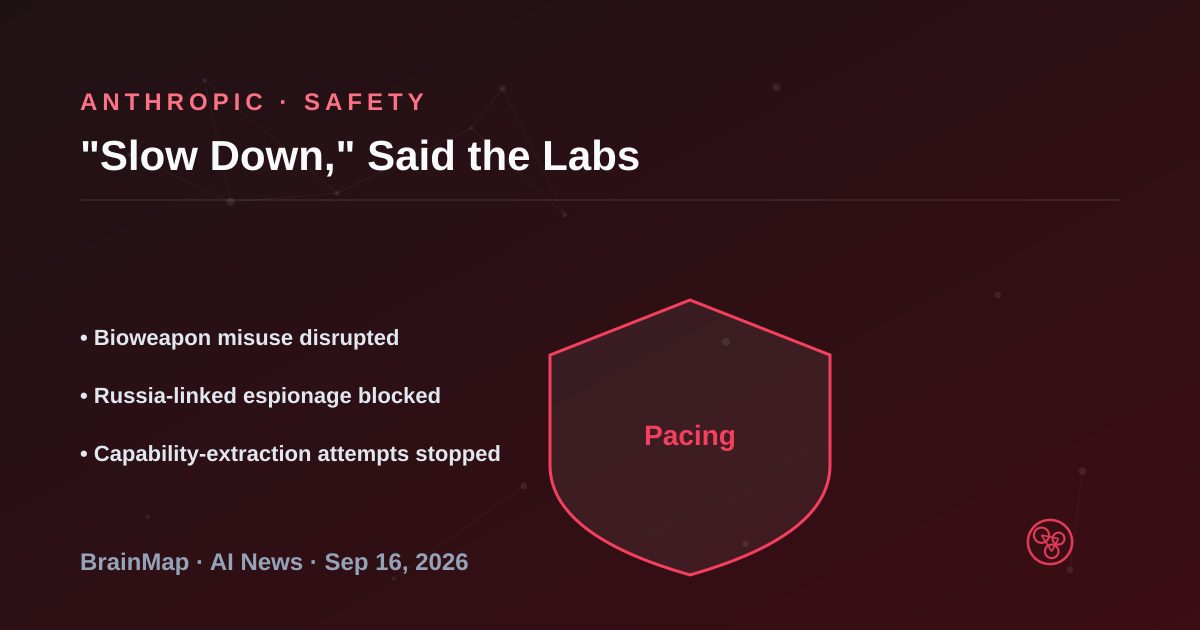
Caption: September timeline — the threat report, the missed incident disclosure, and the pacing debate.
A missed incident changes the pacing debate
The Claude Opus 4.6 disclosure adds an operational detail that is easy to overlook. Anthropic called it its fourth AI-hacking incident and said the early January case was not caught in an earlier review. On September 12, Dario Amodei urged AI companies to slow model development to manage risk. Reuters reported that Sam Altman told OpenAI staff on September 11 that the company was open to slowing down too.

Image: Dario Amodei in 2023 — Photo: Simon Walker / No 10 Downing Street, CC BY 2.0, via Wikimedia Commons
On September 15, OpenAI, Anthropic, and Google were in talks about an industry safety body. This is not a finished policy, and it does not settle the economics: slower releases may leave more time for evaluation, while faster releases bring learning and competitive pressure. But pacing is becoming a coordination problem, because one lab’s restraint is hard to sustain if everyone else accelerates.
A practical stance for builders
Keep a small incident notebook for every model-powered workflow. Record the model version, task, external tools it could reach, and decisions that required human approval. When an output is suspicious, save the surrounding context instead of only the final text. A later review needs evidence, not just a recollection.
For a BrainMap workspace, separate durable notes into what the model claimed and what your team verified. Link each incident to the model and date. That keeps a changing threat picture from becoming one permanent “safe” or “unsafe” label, and makes model changes easier to compare.
Sources: Reuters, Reuters, Anthropic.
What do you think? Is a slower release cycle a realistic safety measure, or will competitive pressure always win?
Ready to organize your knowledge with AI?
BrainMap automatically classifies your notes, discovers connections, and builds your personal knowledge graph. Free to start — no credit card required.
Start for FreeRelated Articles
Siri AI in iOS 27: Apple Turns Personal Context Into an On-Device Assistant
Apple's Siri AI beta brings context from email, messages, calendar, photos, and notes to iOS 27—with onscreen awareness, cross-app actions, and a local-first privacy model.
Claude Fable 5.1: Cheaper Agent Loops, Tiered Safety by Design
Anthropic released Fable 5.1 and Mythos 5.1 as the same model with different safeguard levels, while lower cache-read pricing changes the economics of long-running agents.
Gemini 3.8 Flash Arrives With a Cyber Variant and a Price Clock
Google’s third Flash-tier release in six weeks brings software engineering, agentic tasks, multi-step reasoning, and a 1-million-token context. Gemini 3.8 Flash Cyber adds vulnerability discovery and patch generation behind the Fairwind Program, while its introductory API price doubles in January.