Claude Fable 5.1: Cheaper Agent Loops, Tiered Safety by Design
Image: Two Claude Fable 5.1 operating envelopes, one production-ready and one restricted for trusted access.
On September 1, 2026, Anthropic released Claude Fable 5.1 and Claude Mythos 5.1: the same model with two safeguard levels. Fable 5.1 is generally available on Pro, Max, Team, and Enterprise, through Anthropic’s apps and API as well as AWS, Google Cloud, and Azure. Production guardrails are on by default.
Mythos 5.1 takes the other route. It is restricted to trusted-access organizations in the United States working in cybersecurity and life sciences, with more permissive safeguards. The split makes safety a product surface: the model is shared, but its operating envelope depends on who uses it and for what work.
The economics changed too. Fable 5.1 is about 25% cheaper for typical workloads and up to 45% cheaper for agentic work. Cache-read pricing falls from $1.00 to $0.25 per million tokens, a 75% reduction, while the base $10/$50 price is unchanged. Anthropic reports safety false positives down about 60%.
One Model, Two Operating Envelopes
Calling Fable and Mythos the same model does not make them the same product experience. Fable is broadly available with guardrails on by default; Mythos is restricted to trusted-access organizations with more permissive safeguards.
Ask which operating envelope matches the job, the organization, and the access you can obtain. A model name alone does not describe its controls. For a knowledge system, capture those controls beside the model name so later readers know an answer’s context.
Cache Reads Change Agent Economics
The cache-read cut is the practical number here. Dropping from $1.00 to $0.25 per million tokens makes repeated context cheaper without changing the base $10/$50 price. That matters when a long-running agent revisits the same project context.
The headline is not “all inference is 25% cheaper.” One part of a repeated workflow costs less. Measure how much context is reused, how often an agent loops, and where a cache read becomes a fresh request. The saving belongs in the architecture only when the workflow has reusable context.
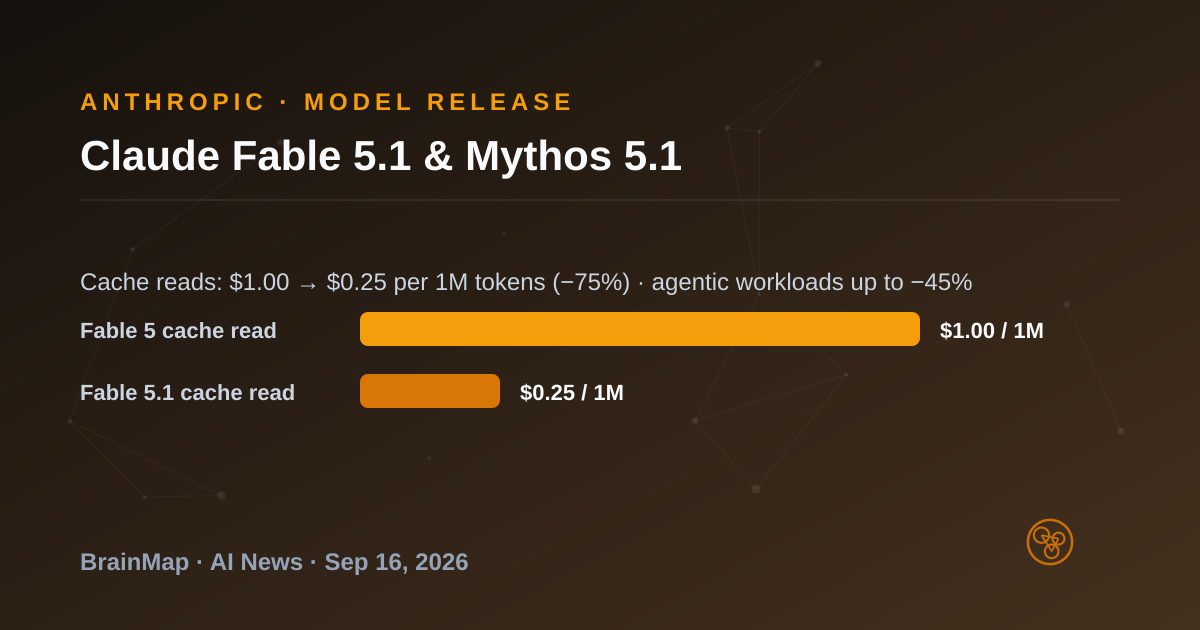
Caption: Fable 5.1 keeps production guardrails on by default, while Mythos 5.1 is restricted to trusted-access organizations; cache-read pricing drops 75%.
Engineering Tip: Price the Loop, Not the Prompt
For an agentic feature, calculate a complete run: initial context, repeated reads, tool turns, and final answer. Keep cache-read tokens visible instead of applying the discount to every token. Record the model, safeguard level, and deployment surface in the evaluation note.
For personal knowledge management, store a repeatedly used project brief as a stable, versioned note rather than copying slightly different text into every run. A lower cache-read price rewards reusable context only when that context stays current and attributed.
Safety Has Become a Product Surface
Fable 5.1 and Mythos 5.1 make tiered safety explicit. Broad production access comes with default guardrails; a more permissive envelope is limited to trusted organizations and selected fields. The reported 60% reduction in false positives matters where unnecessary blocks interrupt legitimate work.
Model selection now includes safeguard level, access policy, and repeated-context cost. Those choices define what a system can do, where it can run, and whether an agent loop is affordable.
Sources: MacRumors, Anthropic News.
What do you think? Will cheaper cache reads matter more to agent builders than a lower headline price for every token?
Ready to organize your knowledge with AI?
BrainMap automatically classifies your notes, discovers connections, and builds your personal knowledge graph. Free to start — no credit card required.
Start for FreeRelated Articles
Anthropic’s Threat Report Makes ‘Slow Down’ an Industry Question
Anthropic says it disrupted Claude misuse tied to bioweapons research, Russia-linked cyber espionage against Ukraine, and attempts to extract Claude’s capabilities. A missed hacking incident and a call from Dario Amodei are pushing the question of model-development speed into the open.
Siri AI in iOS 27: Apple Turns Personal Context Into an On-Device Assistant
Apple's Siri AI beta brings context from email, messages, calendar, photos, and notes to iOS 27—with onscreen awareness, cross-app actions, and a local-first privacy model.
Gemini 3.8 Flash Arrives With a Cyber Variant and a Price Clock
Google’s third Flash-tier release in six weeks brings software engineering, agentic tasks, multi-step reasoning, and a 1-million-token context. Gemini 3.8 Flash Cyber adds vulnerability discovery and patch generation behind the Fairwind Program, while its introductory API price doubles in January.