Agentic Workflow Runtimes Are the New Middleware
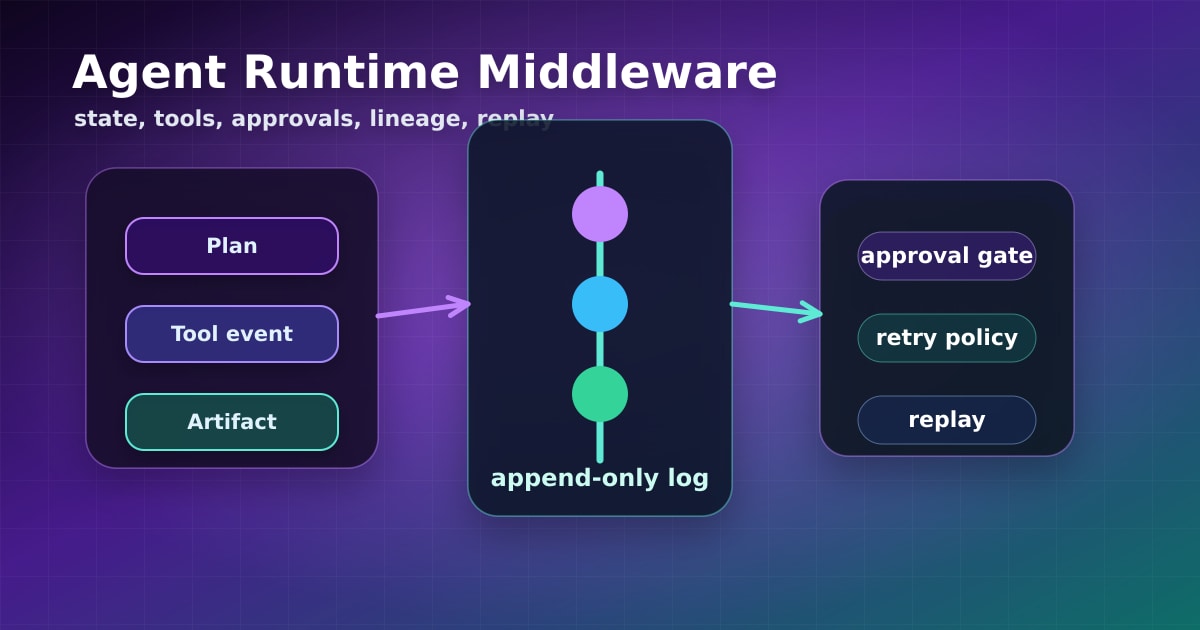
Agentic AI is moving from demos into production, and the hard part is no longer the chat box. It is the runtime. Recent reporting on enterprise adoption shows that many organizations are interested in agents but struggle to operationalize them because orchestration, governance, identity, and verification are still immature. Research on execution lineage points in the same direction: long-running AI work needs explicit state and reproducible dependencies.
Why Agents Need Runtimes
A useful agent does not just answer. It plans, reads, calls tools, waits for approvals, handles errors, updates artifacts, and resumes later. That requires infrastructure similar to workflow engines: durable state, retries, timeouts, permissions, observability, and versioned execution history.
Without a runtime, teams end up with fragile prompt loops. They may work in a demo, but they become difficult to debug once the agent touches real systems and runs for more than a few steps.
Lineage Beats Conversation Logs
Conversation history is not enough for serious agentic work. Teams need to know which artifact came from which source, which tool call changed it, which model version made the decision, and which human approved it. Execution lineage gives each intermediate output an identity, dependency list, and replay path.
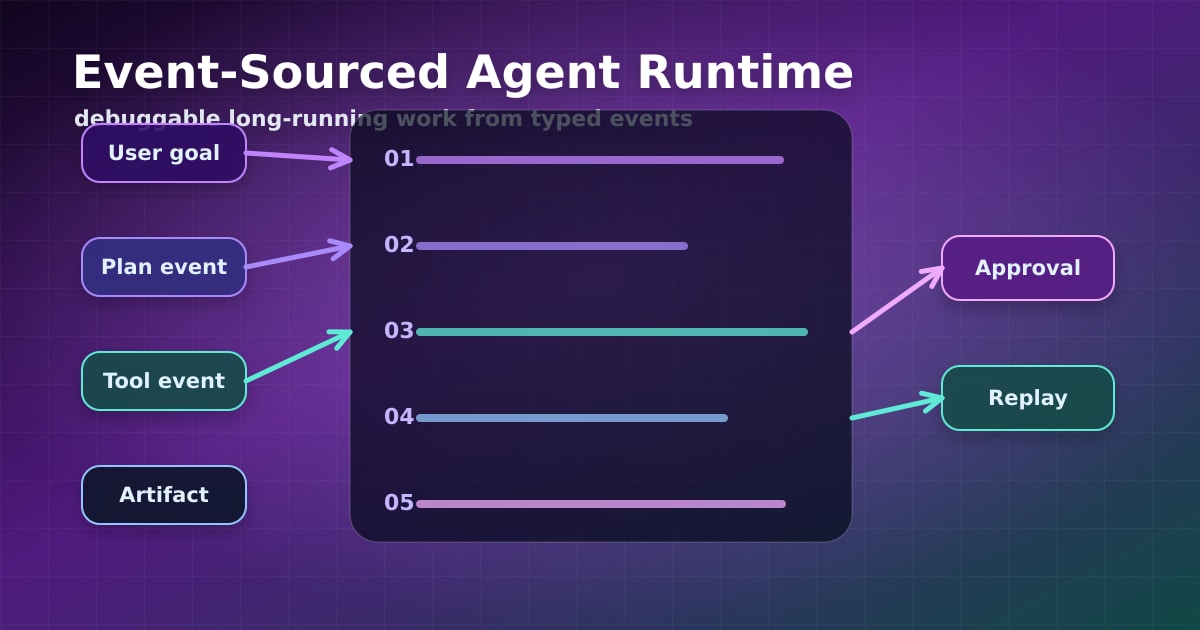
Caption: A production agent runtime coordinates planning, tools, memory, approvals, lineage, and replay.
This is especially important for knowledge work. If a source document changes, the runtime should update affected artifacts without rewriting unrelated branches.
Engineering Tip: Model Agent Steps as Typed Events
Represent every agent step as a typed event: plan_created, tool_requested, tool_completed, artifact_written, approval_requested, approval_granted, policy_blocked, and run_completed. Store these events append-only.
Build the UI from the event stream instead of from an opaque final answer. That gives users a live progress view and gives engineers a debuggable audit trail. Add deterministic replay for tool outputs when possible, and freeze prompt templates per run. The more autonomous the agent becomes, the more boring and explicit the runtime should be.
Sources: ITPro on enterprise agent adoption, Execution Lineage paper, SafeAgent paper.
What do you think? Are agent runtimes becoming a new platform layer like databases and queues?
Ready to organize your knowledge with AI?
BrainMap automatically classifies your notes, discovers connections, and builds your personal knowledge graph. Free to start — no credit card required.
Start for FreeRelated Articles
Anthropic’s Threat Report Makes ‘Slow Down’ an Industry Question
Anthropic says it disrupted Claude misuse tied to bioweapons research, Russia-linked cyber espionage against Ukraine, and attempts to extract Claude’s capabilities. A missed hacking incident and a call from Dario Amodei are pushing the question of model-development speed into the open.
Siri AI in iOS 27: Apple Turns Personal Context Into an On-Device Assistant
Apple's Siri AI beta brings context from email, messages, calendar, photos, and notes to iOS 27—with onscreen awareness, cross-app actions, and a local-first privacy model.
Claude Fable 5.1: Cheaper Agent Loops, Tiered Safety by Design
Anthropic released Fable 5.1 and Mythos 5.1 as the same model with different safeguard levels, while lower cache-read pricing changes the economics of long-running agents.