Anthropic Fable 5 Turns Model Safety Into an Operations Problem
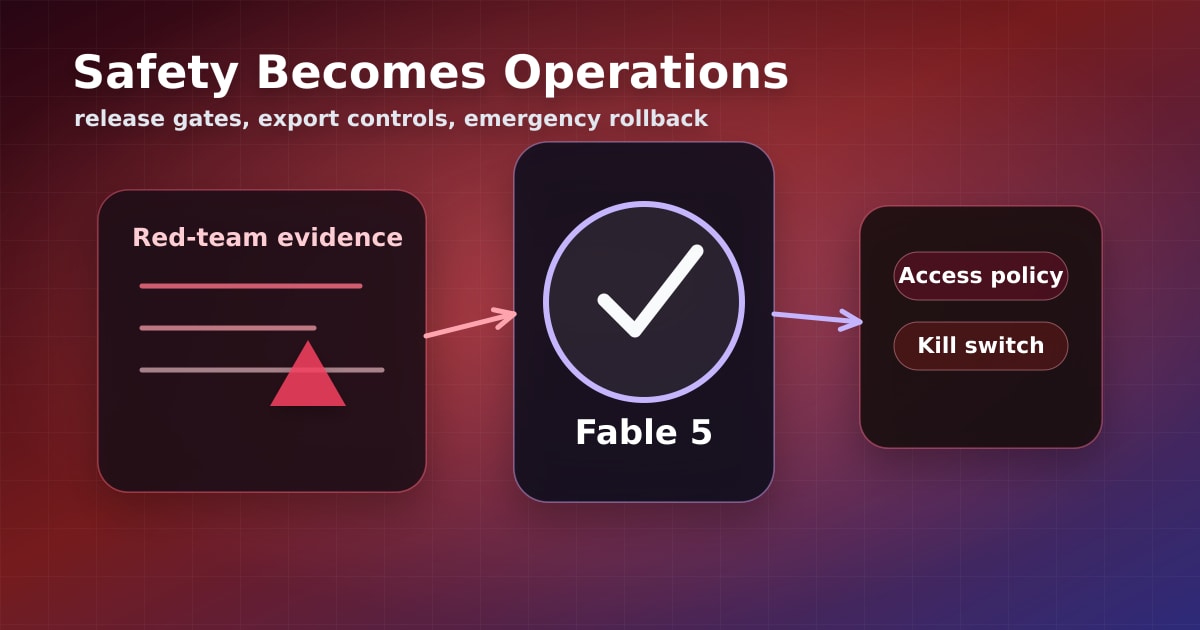
Anthropic's Fable 5 story is no longer only about model quality. Reports from AP, The Verge, and other outlets describe a fast-moving dispute in which U.S. officials ordered restrictions on Anthropic's newest Fable 5 and Mythos 5 models over national-security concerns. Anthropic disputed the severity of the reported vulnerability, but the practical result was immediate: advanced model access became an operational, legal, and geopolitical issue.
The New Shape of Frontier Model Risk
Older AI safety conversations often focused on whether a model would refuse harmful prompts. Fable 5 shows a broader risk surface. A frontier system can be affected by red-team findings, customer reports, export-control language, employee nationality rules, cloud access controls, and the provider's ability to disable or segment service quickly.
This matters for builders because model access is now a dependency with regulatory state. A feature that works on Friday can become unavailable on Monday, not because the API broke, but because the allowed user population changed.
Why Guardrails Are Not Enough
Guardrails are necessary, but they are not the whole control plane. A serious model deployment needs release gates, abuse monitoring, incident response, privileged access controls, and documented rollback procedures. If a reported jailbreak implies access to cyber-sensitive workflows, teams need a way to isolate the affected capability without disabling unrelated products.
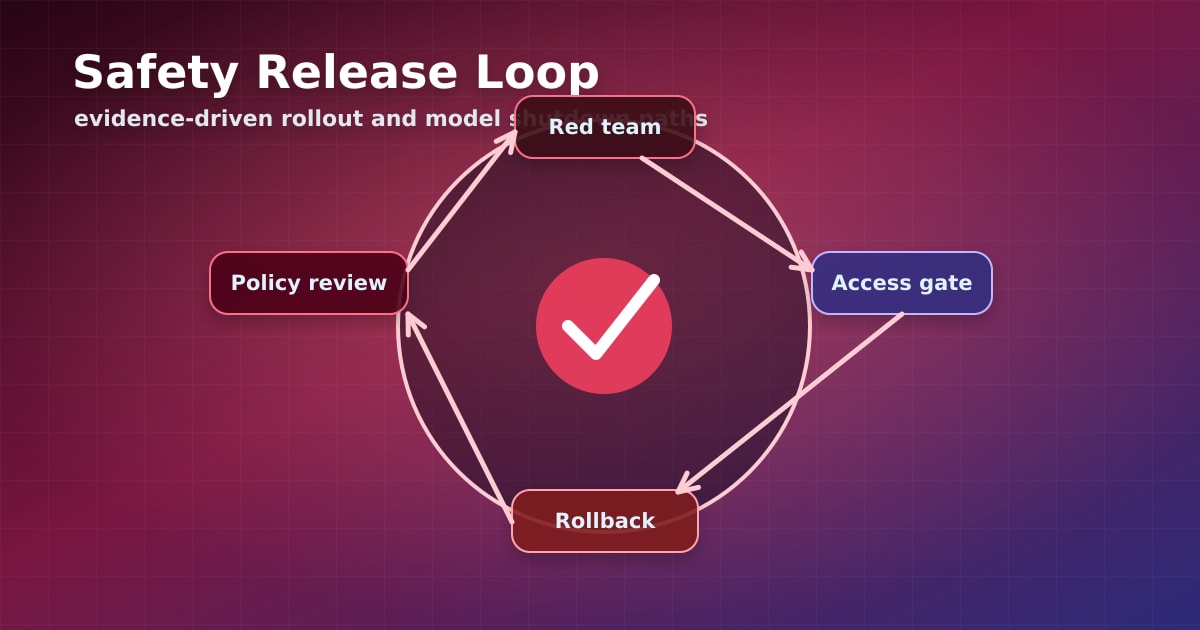
Caption: Frontier model safety now spans red-team evidence, policy review, access control, and runtime shutdown paths.
For product teams, the lesson is direct: do not couple your entire workflow to one model tier unless you can tolerate sudden interruption. Resilience is not only an uptime property. It is also a policy-change property.
Engineering Tip: Build a Model Access Control Plane
Create an internal layer between your application and every frontier model provider. That layer should map users, regions, tasks, and data classes to allowed model routes. Keep provider-specific model IDs out of product code, and make route changes deployable through configuration.
Add circuit breakers for safety incidents, per-capability fallbacks, and a kill switch that disables only the risky tool path. For higher-risk features, require signed policy records before enabling a model for production traffic. When an incident happens, you want to answer three questions quickly: who used the model, for what task, and what alternative path is safe enough to keep the product running?
Sources: AP News, The Verge, Axios.
What do you think? Should advanced model releases be governed like cloud infrastructure changes, with staged rollout and mandatory rollback plans?
Ready to organize your knowledge with AI?
BrainMap automatically classifies your notes, discovers connections, and builds your personal knowledge graph. Free to start — no credit card required.
Start for FreeRelated Articles
Anthropic’s Threat Report Makes ‘Slow Down’ an Industry Question
Anthropic says it disrupted Claude misuse tied to bioweapons research, Russia-linked cyber espionage against Ukraine, and attempts to extract Claude’s capabilities. A missed hacking incident and a call from Dario Amodei are pushing the question of model-development speed into the open.
Siri AI in iOS 27: Apple Turns Personal Context Into an On-Device Assistant
Apple's Siri AI beta brings context from email, messages, calendar, photos, and notes to iOS 27—with onscreen awareness, cross-app actions, and a local-first privacy model.
Claude Fable 5.1: Cheaper Agent Loops, Tiered Safety by Design
Anthropic released Fable 5.1 and Mythos 5.1 as the same model with different safeguard levels, while lower cache-read pricing changes the economics of long-running agents.