Fable 5 Is Back: What 19 Days of Export Controls Taught AI Operators
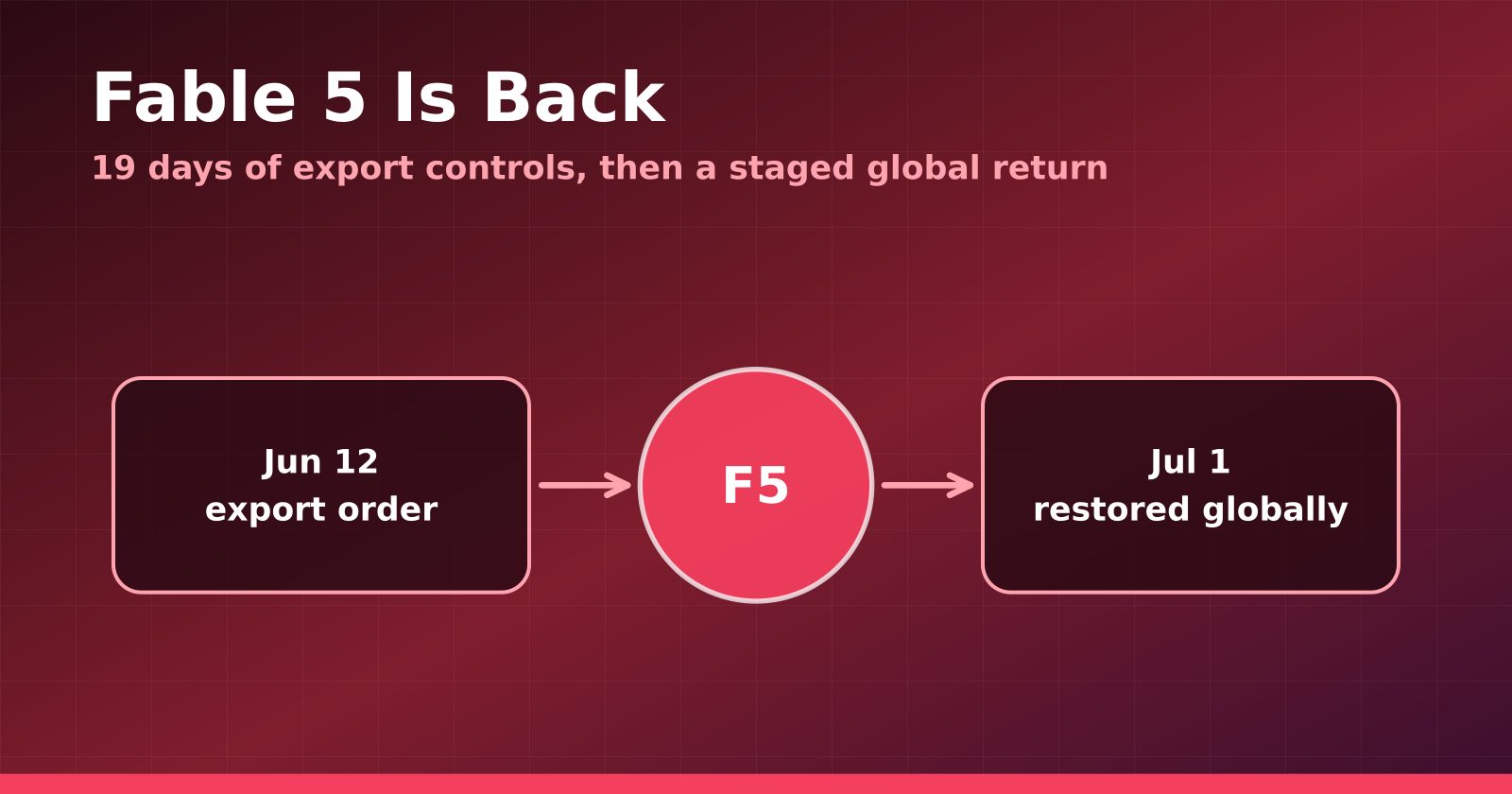
The most closely watched AI policy standoff of 2026 just resolved. On June 30, the US Commerce Department lifted the export controls it imposed on Claude Fable 5 and Mythos 5 on June 12, and Anthropic restored global access on July 1 — across the Claude Platform, Claude.ai, Claude Code, and Claude Cowork. The shutdown lasted 19 days, triggered by an Amazon research report showing Fable 5's cybersecurity safeguards could be bypassed to identify software vulnerabilities.
The Restoration Is Also a Policy Artifact
What came back is not just a model; it is a new operating agreement. Alongside the redeployment, Anthropic launched a formal bug bounty with HackerOne for cyber-jailbreak research, giving security researchers a controlled testing environment and a responsible disclosure path. It also proposed a two-axis jailbreak severity framework — scoring attack accessibility against harm potential — designed to keep future incidents from triggering disproportionate responses. By that rubric, the Amazon jailbreak would have scored moderate, not critical.
The rollout itself is measured: Pro, Max, Team, and select Enterprise plans get Fable 5 within 50% of weekly usage limits through July 7, then via usage credits. Even restoration ships in stages now.
Nineteen Days Is a Number Worth Remembering
When we covered the original order in June, the takeaway was that model access had become a dependency with regulatory state. The episode now has hard numbers: a frontier model that was live for three days, offline for nineteen, and restored under new terms. Teams that had routed critical workflows exclusively through Fable 5 spent most of a month on fallbacks; teams with a model-routing layer changed a config value.
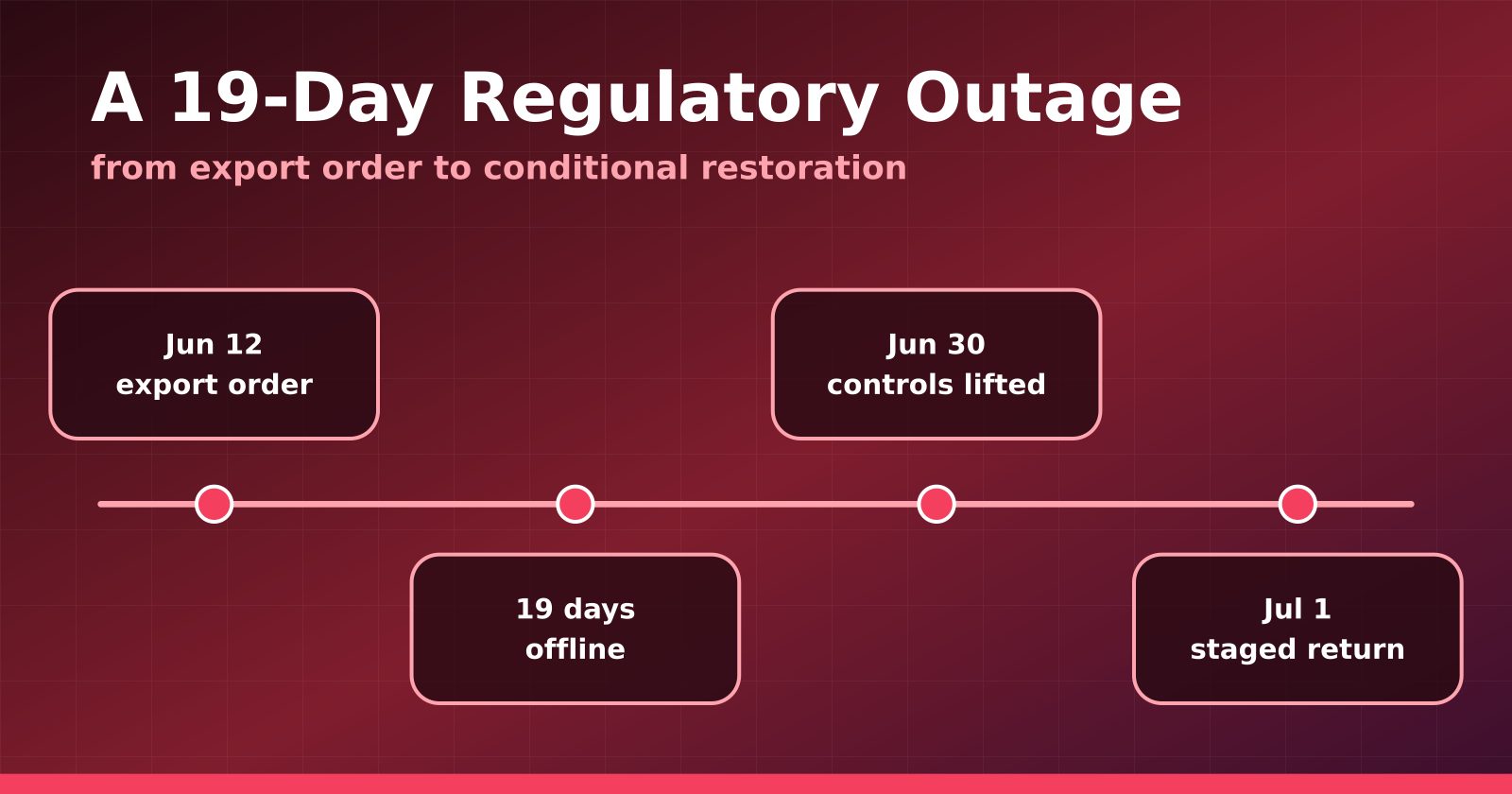
Caption: June 12 export order, 19 days offline, June 30 lift, July 1 staged global return — with a severity framework attached.
Engineering Tip: Run a Post-Incident Review Even If You Weren't Hit
Treat the Fable 5 window as a free tabletop exercise. Answer three questions with evidence, not intuition. Which of your features would have degraded on June 12, and how would you have noticed — an alert, or a user complaint? How long would swapping to your fallback model actually take — including the eval run you would want before shipping it? And did your fallback stay warm — do you have current benchmarks for it, or last quarter's?
Then encode the answers: a routing config that names a fallback per capability, a scheduled job that runs your eval suite against the fallback monthly, and an alert on provider policy channels, not just status pages. The next 19-day window is a matter of when, not if — and it may not end with restoration.
Sources: Anthropic, VentureBeat, The Hacker News.
What do you think? Should jailbreak severity frameworks be industry-standardized like CVE scores, or does each lab's threat model differ too much?
Ready to organize your knowledge with AI?
BrainMap automatically classifies your notes, discovers connections, and builds your personal knowledge graph. Free to start — no credit card required.
Start for FreeRelated Articles
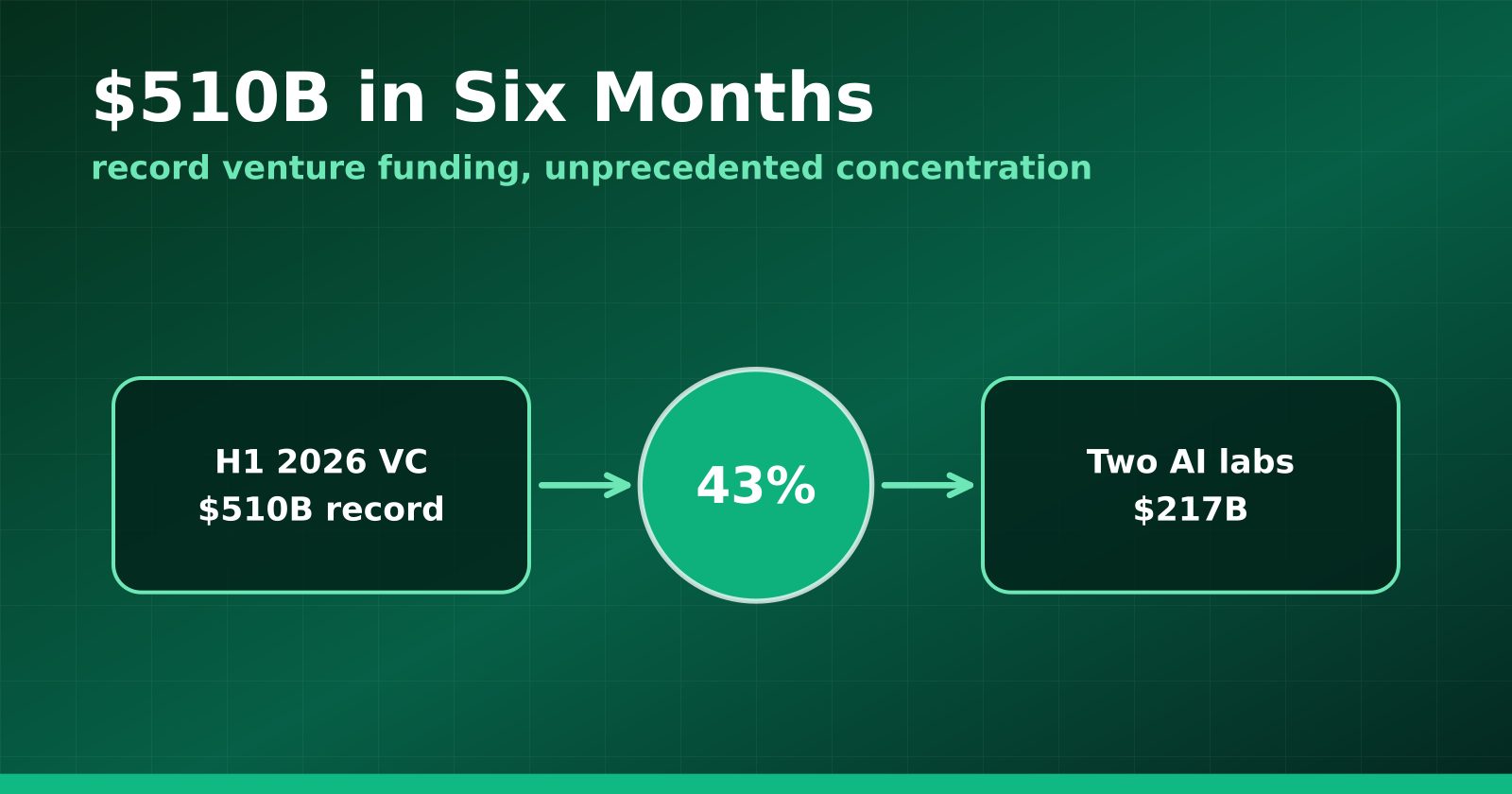
H1 2026 Venture Funding Hit a Record $510B — and Two AI Labs Took 43%
Crunchbase's half-year report shows global VC at an all-time high, with OpenAI and Anthropic alone absorbing $217 billion and AI claiming roughly two-thirds of all deployment.
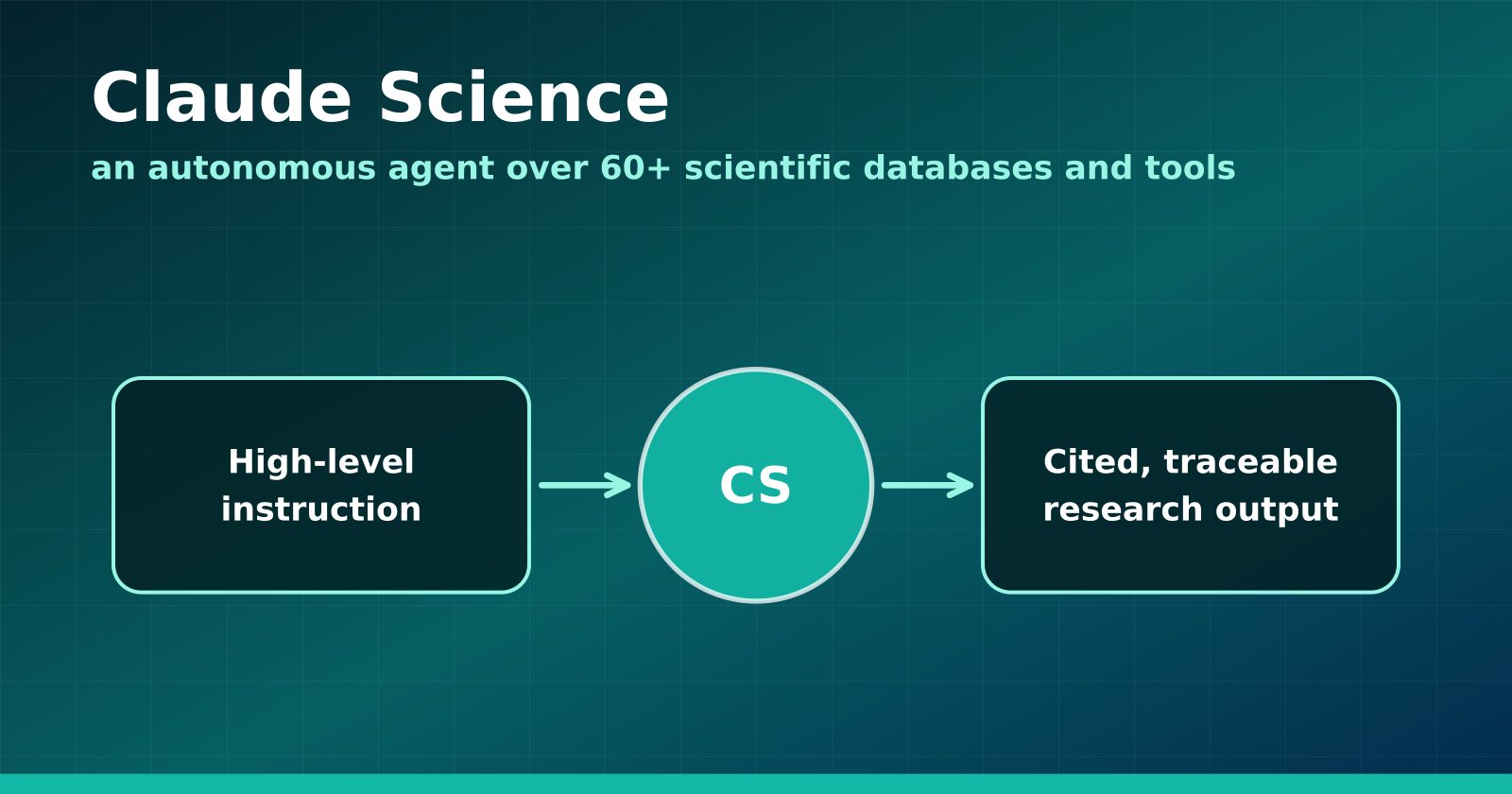
Claude Science Turns the Research Workbench Into an Agent Surface
Anthropic's new flagship product wires 60+ scientific databases and computation tools into an autonomous research agent — and Anthropic is using it to hunt drugs for neglected diseases.
Claude Sonnet 5 Makes Near-Frontier Performance the Default Tier
Anthropic's Sonnet 5 launches at $2 per million input tokens, approaches Opus 4.8 on agentic benchmarks, and becomes the default for Free and Pro users.