Microsoft MAI-Thinking-1 and the Enterprise Reasoning Stack
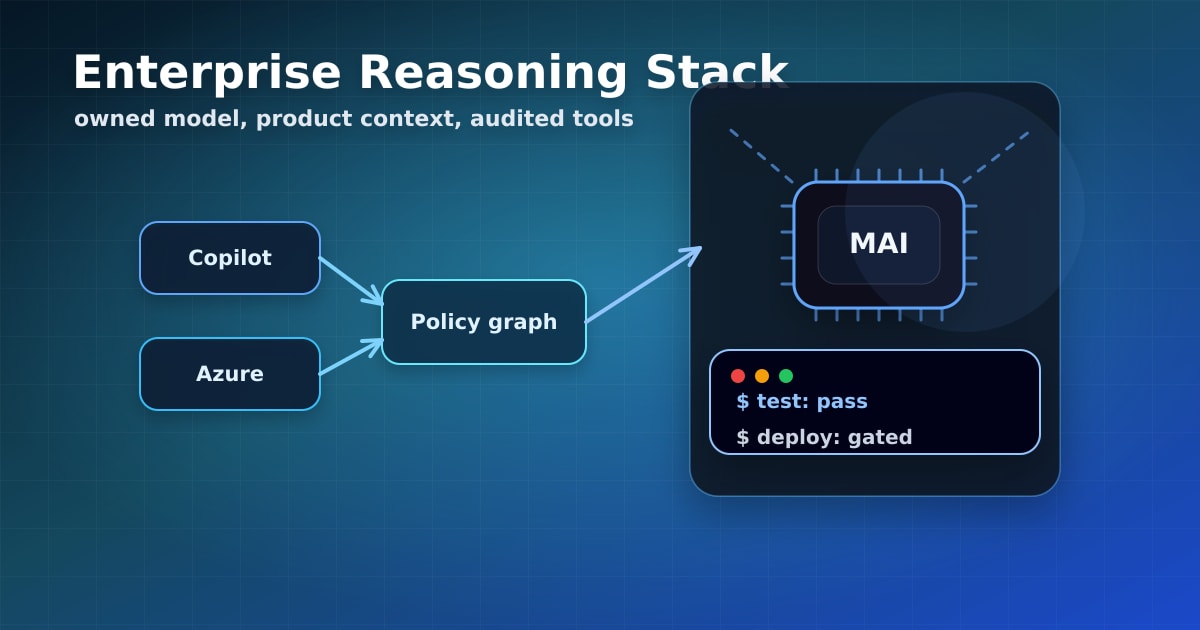
Microsoft's MAI-Thinking-1 announcement matters because it moves the company from model integrator toward model owner. Reports from Build 2026 describe MAI-Thinking-1 as a midsized, first-party reasoning model aimed at software engineering and multi-step work, alongside lighter MAI models for coding, voice, image, and transcription tasks. For developers, the headline is not just another model name. It is a signal that enterprise AI stacks are becoming more vertically integrated.
What Microsoft Is Really Optimizing
MAI-Thinking-1 is positioned around useful reasoning per dollar, not only benchmark spectacle. That distinction matters for products such as GitHub Copilot, Visual Studio Code, Microsoft 365, and Azure AI Foundry, where inference cost, latency, governance, and availability are often more important than a leaderboard win.
The strategic pattern is clear: own the model, run it on owned cloud infrastructure, tune it for owned product surfaces, and expose it through developer tooling. A reasoning model that is designed for Microsoft's workflows can be optimized for code review, issue triage, document analysis, and enterprise policy constraints in ways that a generic frontier endpoint may not be.
Why Reasoning Models Need Product Context
Reasoning models are most valuable when they can plan, call tools, inspect artifacts, and recover from partial failure. In a developer environment, that means the model needs access to repo structure, test output, dependency graphs, issue history, and deployment constraints. In an enterprise environment, it also needs tenant boundaries, audit logs, role-based permissions, and data residency guarantees.
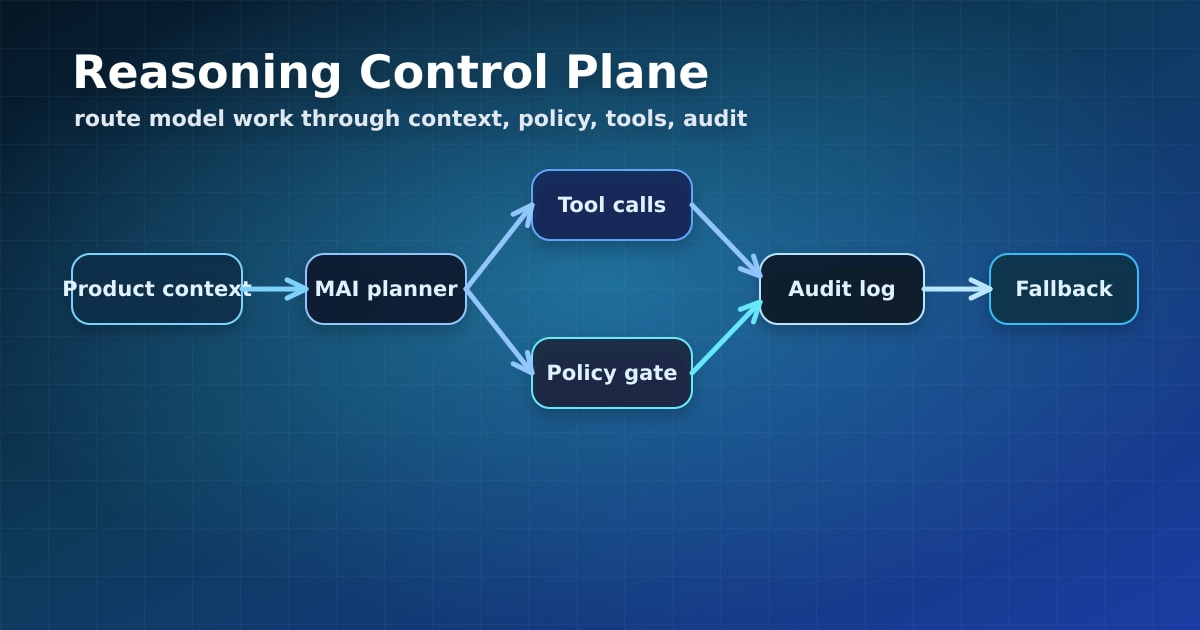
Caption: A first-party reasoning model can sit between product context, enterprise policy, and tool execution.
When the model and the product platform share the same operational owner, the system can make tighter choices about caching, routing, model fallback, and observability. That is the real MAI-Thinking story: reasoning is becoming infrastructure, not just a chat feature.
Engineering Tip: Design Reasoning as a Job System
Do not treat deep reasoning calls like simple HTTP completions. Put long-running model work behind a durable job queue with explicit states such as queued, planning, executing_tools, needs_review, failed, and complete.
Store intermediate artifacts separately from final answers, stream progress events to the UI, and set hard budgets for tokens, tool calls, and wall-clock time. Add a fast fallback model for partial answers when the reasoning job exceeds its budget. For enterprise apps, log model version, prompt template version, tool inputs, tool outputs, and user approval decisions so every recommendation can be audited later.
Sources: The Verge, Axios, Windows Central.
What do you think? Will first-party reasoning models make enterprise AI more reliable, or will they make each platform harder to compare?
Ready to organize your knowledge with AI?
BrainMap automatically classifies your notes, discovers connections, and builds your personal knowledge graph. Free to start — no credit card required.
Start for FreeRelated Articles
Anthropic’s Threat Report Makes ‘Slow Down’ an Industry Question
Anthropic says it disrupted Claude misuse tied to bioweapons research, Russia-linked cyber espionage against Ukraine, and attempts to extract Claude’s capabilities. A missed hacking incident and a call from Dario Amodei are pushing the question of model-development speed into the open.
Siri AI in iOS 27: Apple Turns Personal Context Into an On-Device Assistant
Apple's Siri AI beta brings context from email, messages, calendar, photos, and notes to iOS 27—with onscreen awareness, cross-app actions, and a local-first privacy model.
Claude Fable 5.1: Cheaper Agent Loops, Tiered Safety by Design
Anthropic released Fable 5.1 and Mythos 5.1 as the same model with different safeguard levels, while lower cache-read pricing changes the economics of long-running agents.