Mistral’s €3 Billion Raise Makes Sovereign Open-Weight AI Investable
Image: Europe's largest AI funding round — €3B raised at a valuation above €21B.
On September 8, Mistral AI announced a €3 billion Series D at a post-money valuation above €21 billion (about $3.5 billion raised and a $24 billion valuation). It is the largest equity round ever raised by a European technology company, nearly doubling Mistral’s €11.7 billion valuation from September 2025. The company reached that mark three years after founding.
The size matters, but the framing matters more. Mistral calls itself “sovereign, open-weight AI”: a European frontier lab with capital to build more independent compute while keeping open weights central. For builders, the question is what happens when strategic independence becomes a funded operating plan rather than a small lab’s aspiration.
A European Capital Stack for Frontier Ambition
The round was co-led by Samsung Electronics, the EU-backed Scaleup Europe Fund (EQT), and PSG Equity. New investors include Advent, the Grand Duchy of Luxembourg, and BlackRock funds. Returning backers are ASML, NVIDIA, BNP Paribas, Bpifrance, Salesforce Ventures, General Catalyst, a16z, Index, and Lightspeed.
What the Money Is Meant to Buy
Mistral says proceeds will support independent European compute, frontier research, and commercial scale. It plans to triple its Singapore headcount, while Calcalist reports that Mistral is on track for approximately $1 billion in annual recurring revenue. The pitch pairs strategic control with a global business rather than treating sovereignty as isolation.
For anyone choosing an AI stack, a model can be open-weight while its surrounding service, hardware, or workflow remains dependent elsewhere. This raise makes open weights more credible as a durable strategy; it does not replace inspection from your data to the deployed artifact.
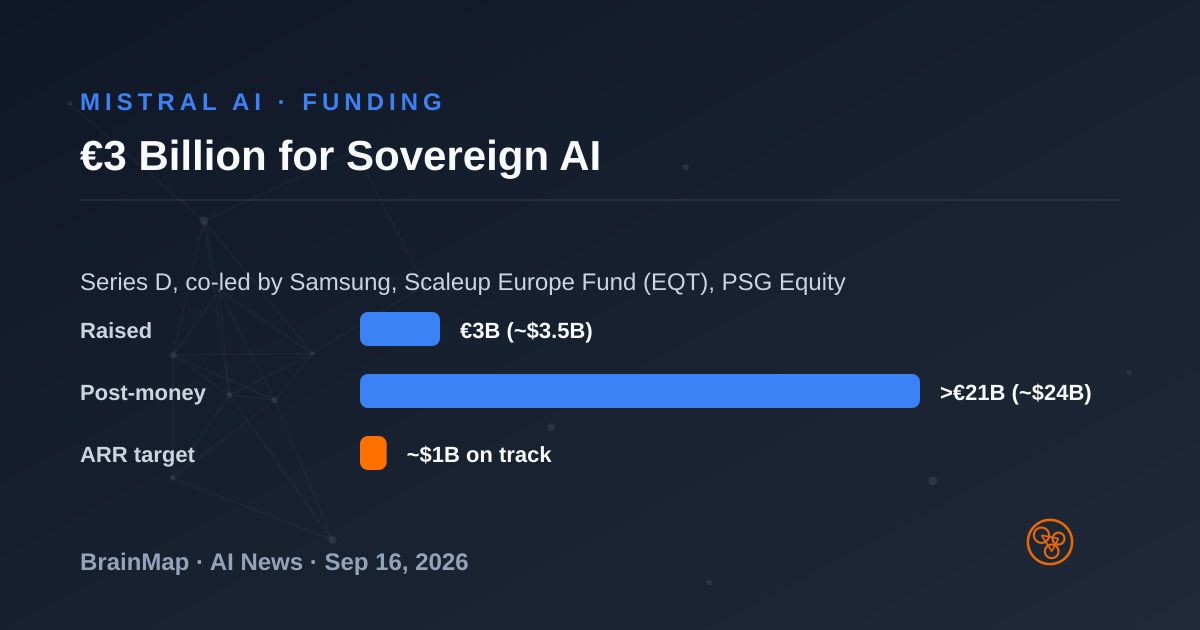
Caption: €3B raised, >€21B post-money, ~$1B ARR on track.
What Open Weights Change for Builders
For teams handling sensitive notes, proprietary research, or regulated material, open weights can change the control surface. You can evaluate a specific artifact, choose where inference happens, and design around a model you can keep available rather than an endpoint that may change. Freedom still depends on the model’s terms and your infrastructure, so “open” is a capability to verify, not a trust shortcut.
Builder’s Check: Turn Sovereignty Into a Test
Before adopting an open-weight model, ask four questions. Where does raw data travel? Which component performs inference? Can you reproduce the deployed artifact and record its exact version? What happens if a provider, investor, or region becomes unavailable? Record the answers alongside latency and cost, not just in a strategy deck.
For BrainMap-style knowledge work, separate the vault from the model service, keep an exportable record of the model and prompts used for important synthesis, and make sure switching models does not erase context. Mistral’s round signals that data control may become a product differentiator; your architecture decides whether you own it.
Sources: Mistral AI, Reuters, CNBC.
What do you think? Does a well-funded European open-weight lab change how you would choose a model for work that cannot surrender data control?
Ready to organize your knowledge with AI?
BrainMap automatically classifies your notes, discovers connections, and builds your personal knowledge graph. Free to start — no credit card required.
Start for FreeRelated Articles
Anthropic’s Threat Report Makes ‘Slow Down’ an Industry Question
Anthropic says it disrupted Claude misuse tied to bioweapons research, Russia-linked cyber espionage against Ukraine, and attempts to extract Claude’s capabilities. A missed hacking incident and a call from Dario Amodei are pushing the question of model-development speed into the open.
Siri AI in iOS 27: Apple Turns Personal Context Into an On-Device Assistant
Apple's Siri AI beta brings context from email, messages, calendar, photos, and notes to iOS 27—with onscreen awareness, cross-app actions, and a local-first privacy model.
Claude Fable 5.1: Cheaper Agent Loops, Tiered Safety by Design
Anthropic released Fable 5.1 and Mythos 5.1 as the same model with different safeguard levels, while lower cache-read pricing changes the economics of long-running agents.