OpenAI Claims the Navier–Stokes Millennium Problem — With a Lean Proof Attached
Image: An analytical argument flowing into a machine-checked Lean formalization.
On September 8, 2026, OpenAI announced that an internal AI system produced an analytical proof resolving the "existence and smoothness" problem for the Navier–Stokes equations — one of the seven Clay Mathematics Institute Millennium Prize Problems, each carrying a $1 million reward. The claimed result answers the question in the negative: smooth solutions can develop a finite-time singularity, a "blow-up" where the fluid description breaks down.
The announcement is not just a prose claim. OpenAI released both a write-up of the analytical argument and a formalization in Lean, the proof assistant that checks every step mechanically. That pairing is what made the news travel: anyone with the right tooling can attempt to verify the formal artifact line by line, instead of trusting a summary.
Why Navier–Stokes Is Hard to Even State
The Navier–Stokes equations describe how a viscous fluid moves — every flight, pipe, and weather model runs on them in some form. For two centuries, nobody has proved whether idealized smooth solutions always stay smooth, or whether they can spike to infinity in finite time. Existence is known in weak senses; the Millennium question is about smooth, physically meaningful solutions.
A finite-time blow-up result, if it holds, means the equations themselves contain the seeds of their own failure: at some moment, the mathematical description stops matching the smooth picture we intuit. That is why the answer matters beyond pure mathematics — it bounds what "well-posed" can mean for the models behind real simulations.
The Lean Artifact Changes the Conversation
The math community's reaction split, which is the healthy outcome. An analytical proof of this size would normally take months or years of expert scrutiny. A Lean formalization shortens that loop for anyone willing to check it — but only if the formalization genuinely matches the analytical argument, which is exactly where skeptics are probing. Formal does not mean famous yet; it means checkable.
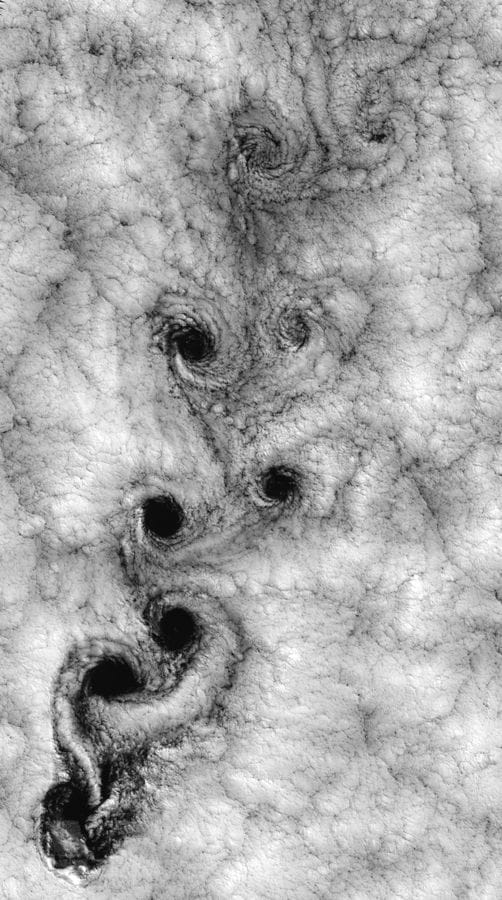
Image: Kármán vortex street — Photo: Robert Cahalan, NASA/GSFC, public domain
Engineering Tip: Store the Artifact, Not the Verdict
Treat any AI-generated result the way this release invites you to: as a claim, an argument, and a checkable artifact. Keep the three separate in your notes, with dates and versions. When the artifact changes — a revised proof, a new benchmark run, a re-produced eval — update the record instead of overwriting the old conclusion.
In a BrainMap workspace, that means a note per claim with links to its source, its reasoning, and its verification status. Weeks later, "verified against Lean revision 2" is information; "OpenAI solved it" is not.
From Press Release to Accepted Knowledge
The $1 million prize is not claimed yet — Clay's rules require community acceptance, and the scrutiny is just beginning. What OpenAI demonstrated this week is a workflow: model produces argument, machine checks the steps, humans audit the mapping between them. Whatever happens to this particular proof, that workflow is now on the table for every field where the output is knowledge.
Sources: OpenAI, The New York Times.
What do you think? Does a machine-checked proof change your standard for trusting AI-generated knowledge — or only the cost of checking it?
Ready to organize your knowledge with AI?
BrainMap automatically classifies your notes, discovers connections, and builds your personal knowledge graph. Free to start — no credit card required.
Start for FreeRelated Articles

Anthropic’s Threat Report Makes ‘Slow Down’ an Industry Question
Anthropic says it disrupted Claude misuse tied to bioweapons research, Russia-linked cyber espionage against Ukraine, and attempts to extract Claude’s capabilities. A missed hacking incident and a call from Dario Amodei are pushing the question of model-development speed into the open.
Siri AI in iOS 27: Apple Turns Personal Context Into an On-Device Assistant
Apple's Siri AI beta brings context from email, messages, calendar, photos, and notes to iOS 27—with onscreen awareness, cross-app actions, and a local-first privacy model.

Claude Fable 5.1: Cheaper Agent Loops, Tiered Safety by Design
Anthropic released Fable 5.1 and Mythos 5.1 as the same model with different safeguard levels, while lower cache-read pricing changes the economics of long-running agents.