Starcloud and the Case for Space-Based AI Compute
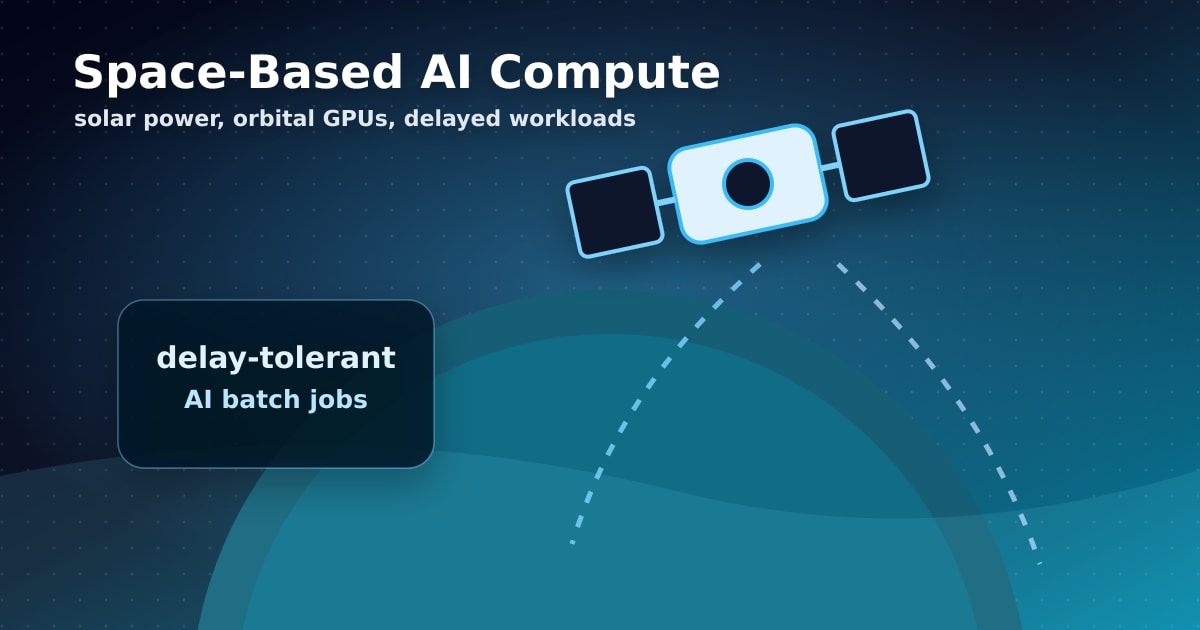
Space-based compute sounds like science fiction until you look at the AI data-center problem: power demand, cooling, land constraints, permitting, carbon pressure, and network growth. Starcloud and other orbital data-center efforts are exploring whether satellites can host meaningful AI workloads by using abundant solar energy, radiative cooling, and increasingly cheaper launch capacity.
Why Orbit Is Attractive
In low Earth orbit, solar exposure can be more predictable than many terrestrial sites, and heat can be radiated into space without water-hungry cooling systems. For some workloads, especially data generated in orbit or delay-tolerant batch processing, putting compute near the sensor or near the power source may make architectural sense.
Starcloud's reported plans, including GPU-equipped satellites and larger constellation ambitions, show how quickly the idea has moved from whiteboard to prototype. The broader industry is also watching Google, SpaceX, Blue Origin, and startups explore space-based data-center concepts.
The Hard Constraints Are Still Hard
Orbital compute has brutal engineering constraints. Launch mass is expensive. Radiation can damage electronics. Thermal design is difficult. Hardware repairs are almost impossible. Networking must handle intermittent links, ground-station bottlenecks, and latency that is unacceptable for many interactive applications.
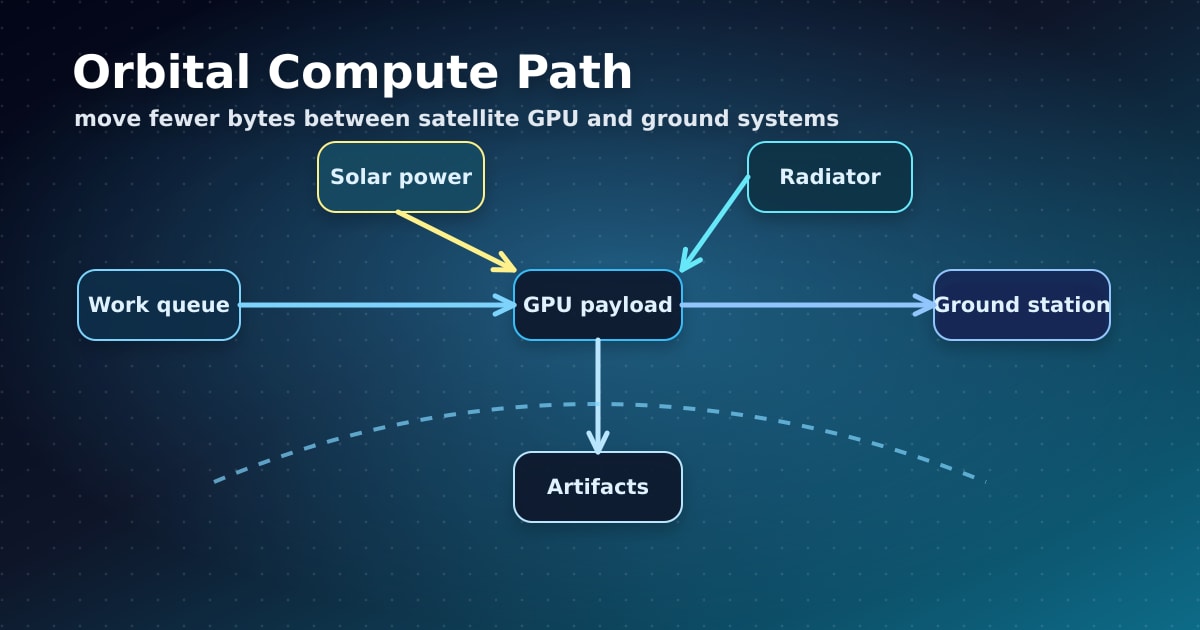
Caption: Space compute must balance solar power, thermal radiation, onboard GPUs, ground links, and workload scheduling.
That means space compute will not replace normal cloud regions. It is more likely to start with specialized workloads: Earth-observation inference, in-orbit data reduction, delay-tolerant AI jobs, and experiments that benefit from solar power economics.
Engineering Tip: Design for Delay-Tolerant Workloads
If you are evaluating orbital or remote compute, start by classifying workloads by latency tolerance and data gravity. Avoid interactive user flows. Favor batch inference, sensor pre-processing, model evaluation, compression, and summarization tasks where minutes of delay are acceptable.
Use store-and-forward queues, content-addressed artifacts, resumable uploads, and idempotent jobs. Assume links fail and results arrive late. Put strict size budgets on inputs and outputs, because downlink bandwidth can become the real bottleneck. The winning architecture will be the one that moves fewer bytes, not the one that runs the flashiest model.
Sources: Starcloud, The Times, SpaceNews.
What do you think? Which AI workloads would you trust to run in orbit first?
Ready to organize your knowledge with AI?
BrainMap automatically classifies your notes, discovers connections, and builds your personal knowledge graph. Free to start — no credit card required.
Start for FreeRelated Articles

Anthropic’s Threat Report Makes ‘Slow Down’ an Industry Question
Anthropic says it disrupted Claude misuse tied to bioweapons research, Russia-linked cyber espionage against Ukraine, and attempts to extract Claude’s capabilities. A missed hacking incident and a call from Dario Amodei are pushing the question of model-development speed into the open.
Siri AI in iOS 27: Apple Turns Personal Context Into an On-Device Assistant
Apple's Siri AI beta brings context from email, messages, calendar, photos, and notes to iOS 27—with onscreen awareness, cross-app actions, and a local-first privacy model.

Claude Fable 5.1: Cheaper Agent Loops, Tiered Safety by Design
Anthropic released Fable 5.1 and Mythos 5.1 as the same model with different safeguard levels, while lower cache-read pricing changes the economics of long-running agents.